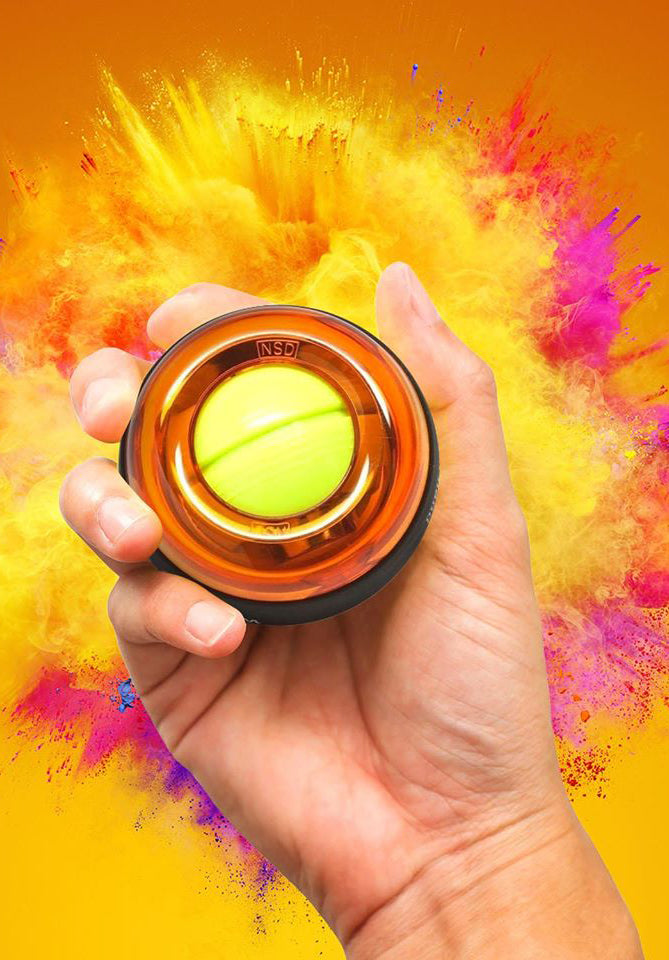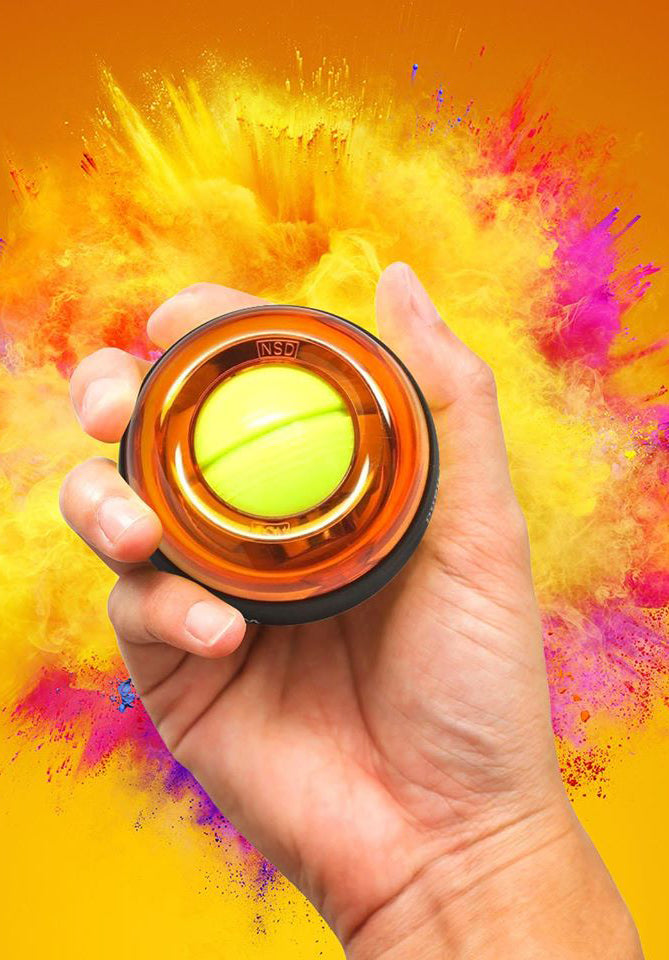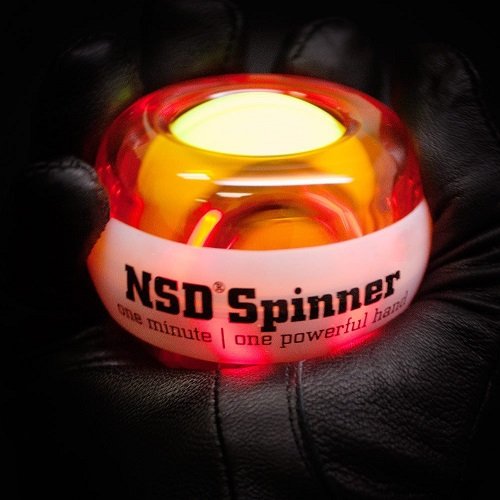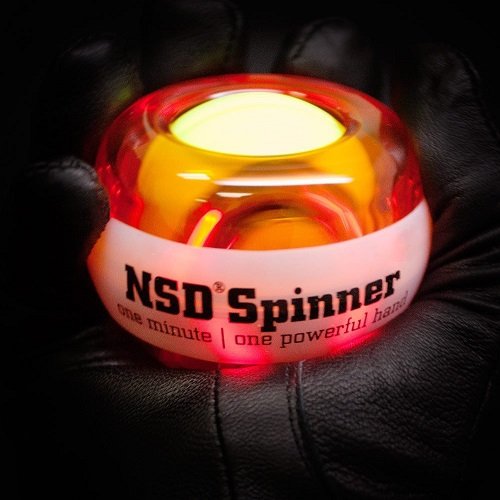
NSD Spinners are scientifically developed to help your arms get the right support they need. Get the right compliment to your arm exercises now.



General education only, not medical advice. Sources are listed at the end.
Wrist pain from gaming usually comes from the same few things: repeated small movements, a bent wrist, a setup that doesn't fit your body, and too many hours without a break. Most of it is fixable. Some of it needs a doctor.
Tingling and numbness point to a nerve. Sharp pain at the base of your thumb points to a tendon. A lump points to something else again. This guide helps you tell them apart, fix your setup, and know when to stop self-managing.
Most gaming wrist pain comes from repetitive strain, awkward wrist angles and a poor desk setup, not from one bad session.
The small muscles and tendons of your hand and forearm do thousands of tiny movements per session: clicks, key presses, thumbstick pushes. Add a bent wrist and no rest, and they get overloaded.
The causes gamers and clinicians mention most:
| Cause | What it looks like |
|---|---|
| Chair or desk at the wrong height | Wrist angled up or down; forearm numbness; pain that eases when you change chairs |
| Bent wrist on mouse or keyboard | Ache in the wrist after an hour or two |
| Mouse that doesn't fit your hand | Pain on one side of the hand or at the base of the thumb |
| Tensing up in intense moments | Gripping hard, pressing the wrist into the desk without noticing |
| Reaching with the little finger | Tendon ache in the wrist or forearm (common with Shift and Ctrl) |
| Elbow resting on a hard armrest | Tingling in the ring and little fingers |
| No breaks | Pain that builds across a session and lingers overnight |
The last row matters most. Researchers surveying esports players find complaints across the body, not only the wrist. Roughly half report eye fatigue, and neck, back and shoulder pain are common (details below).
Get your elbows near 90 degrees, your forearms supported and your wrists straight, then let the chair and desk do the work.
Gamers in forum threads put chair height at the top of the list, often above any gadget. One person's numb forearms cleared up the day after a new chair. Another said the wrist angle changed when the chair was an inch off.
A simple checklist:

It depends on how you use them, and experts disagree. Canada's occupational safety agency (CCOHS) says prolonged pressure on the wrist can restrict blood flow, and that if you use a rest, the pad should support the palm or heel of the hand, not the wrist. A well-adjusted chair and desk may need only light wrist support or none.
Gamers split too. Some say a rest cut their pain a lot; others say it made it worse and floated their wrists instead. Try both and keep what works.
Many gamers report a vertical mouse eased their wrist pain, usually after a few days of adjusting. Others find it awkward for fast shooters. Grip style matters, so try before committing. There's no guarantee, and it won't fix a tendon problem on its own.
Carpal tunnel syndrome (CTS) is pressure on the median nerve at the wrist. It causes tingling, numbness and weakness in the thumb, index, middle and ring fingers, often worse at night.
The American Academy of Orthopaedic Surgeons (AAOS) describes numbness, tingling, burning and pain mainly in those fingers, sometimes travelling up the forearm, with weakness and dropping things. The NHS says it often starts gradually and comes and goes.
Compare the common problems:
| Condition | Typical feeling | Where |
|---|---|---|
| Carpal tunnel syndrome | Tingling, numbness, weak grip, night symptoms | Thumb, index, middle, ring fingers |
| Gamer's thumb (De Quervain's tenosynovitis) | Pain and stiffness with thumb and wrist motion; maybe a tender swelling | Thumb side of the wrist |
| Trigger finger | Catching, popping or locking of a finger | Finger or thumb, tender spot in the palm |
| Cubital tunnel syndrome | Numbness and tingling in the ring and little fingers, worse with a bent elbow | Inside of the elbow, little-finger side |
| Ganglion cyst | A soft, smooth lump, often painless | Wrist or hand |
Tendon irritation is common in gamers too. In a 2019 survey of 500 teenage students in China, 49% tested positive on Finkelstein's test, a screening test for gamer's thumb. Positive results were linked to more frequent mobile gaming, longer sessions and playing with the wrist bent upward. This is a screening result from a survey, not a diagnosis.
Yes. Most people get better with the right treatment, and acting early matters.
So the answer to "is carpal tunnel treatable?" is yes, but "I'll just wait and see" is the risky option.
Gamer's thumb is the common name for De Quervain's tenosynovitis, irritation of the tendons on the thumb side of your wrist.
The AAOS describes pain and stiffness with thumb and wrist movement, sometimes with swelling or a tender lump, caused by rapid, repeated thumb movements on a controller. For treatment it advises stopping the activity that triggers the pain and considering a night splint.
If it keeps coming back, or you can't move your thumb normally, get it checked.

Numbness in the ring and little fingers usually points to the ulnar nerve at the elbow, not the wrist. This is cubital tunnel syndrome.
Common triggers are leaning on your elbow, resting it on a hard armrest, and keeping it bent for a long time, including while you sleep. The AAOS says most cases can be managed with changes in activities (avoiding long periods with the elbow bent and not resting it on hard surfaces) and with night positioning or bracing. It advises seeing a doctor if symptoms are severe or last more than six weeks, because muscle wasting cannot be reversed.
Gamers describe the same pattern: tingling after 45 minutes or so of leaning on an elbow. If that's you, pad the armrest, change your elbow angle, and see a clinician if it keeps happening.
A soft, smooth lump on the wrist or hand is often a ganglion cyst, a harmless fluid-filled swelling. See a doctor to confirm.
The NHS says these are common, often painless, and usually go away on their own within months to a year. Treatment options are watching and waiting, draining with a needle, a steroid injection or surgery, and a cyst can come back.
Do not try to burst or smash it. The NHS warns against popping a ganglion because of the risk of infection or skin damage. See a doctor urgently if it's very painful, hot or red.
Finger locking, cramping or catching, especially in fast, grip-heavy games, can be trigger finger or simple overuse. A clinician can tell which.
Some players report finger cramps within 10 to 15 minutes in combo-heavy games, and say they grip harder when stressed. Try loosening your grip, taking more frequent breaks and checking your hand posture. If a finger catches, locks or stays stuck, or the palm is tender, don't push through it.
If you have a hypermobility condition such as hEDS, or already use splints or see an occupational therapist, ask them what loading and gear is right for you before trying anything new.
Yes. Surveys find eye fatigue, neck, back and shoulder pain at least as often as hand and wrist pain.
Two larger reviews point the same way. A 2022 systematic review of 16 studies and nearly 63,000 gamers found that 11 reported a negative effect of playtime on the musculoskeletal system, most often in the neck, shoulders and back, and that playing more than about 3 hours a day seemed to predict problems. A 2026 meta-analysis of esports players estimated that 73% had pain in the past year and 44% in the past week, though those figures rest on only two and three studies. In that analysis the spine was the most affected region (41%), followed by the upper limbs (31%), with hand and wrist pain pooled at 37% over a year (a very wide range, so treat it as rough). Most included studies were small surveys with unvalidated questionnaires, so use these as a guide, not a forecast.
For your eyes, the American Optometric Association recommends the 20-20-20 rule: take a 20-second break to look at something 20 feet away every 20 minutes. Blink often too.
Take a short break every 30 to 60 minutes: stand, shake out your hands and roll your shoulders. Between matches or loading screens counts.
Stronger forearms may help your hands handle long sessions, and building that capacity before pain starts is one of the smartest prevention moves. Pair it with a good setup and breaks, and see a clinician if you already have symptoms.
Most gamer advice is about reducing load: better chair, softer mouse, more breaks. The other half is raising capacity, so your forearms tire slower under repetitive work.
Why this makes sense:
The NSD Thumb-Wind Start Spinner PB-688AML Purple is a hand-held gyroscopic trainer. There's no string: roll the rotor back with your thumb, release it, and it spins up, then you keep it going with your wrist. NSD lists up to 15,000+ RPM, and the color-changing LED shows how fast you're spinning. The faster it spins, the more your forearm works to control it, so it trains the muscles on both sides of the forearm. A minute or two a day is easy to keep up, even at your desk.

Be clear on what it is:
If you have numbness, tingling or sharp pain, ask a clinician whether and how to add forearm training. Stop if anything makes symptoms worse. Strength training is not a substitute for splinting, activity changes or medical treatment.
👉 Get the NSD Thumb-Wind Start Spinner PB-688AML Purple. Wind it. Spin it. Do it.
Wind or pull to start it, then circle your wrist slowly and match the rotor's rhythm. Timing matters more than speed. That's the part most new users get wrong.
| Spring-loaded (thumb-wind) models | Pull-string (Essential / classic) models | |
|---|---|---|
| Start | Turn the rotor in the arrow's direction with alternating thumbs, about 10 to 15 steps, until resistance builds. Press a thumb on the rotor, then lift it to release. | Push the string's tip into the hole on the rotor, wind it tightly, take your fingers off the rotor, then pull the string sharply. |
| Then | Move it to your hand and rotate your wrist in a circle. Start slowly, speed up gradually, and grip firmly once the rotor is up to speed. | Rotate your wrist in a circle to speed up the rotor. |
The steps below follow NSD's how-to page. The PB-688AML Purple is a spring-loaded thumb-wind model. Tips from NSD and what buyers say:
How long should you use it? NSD describes it as a "minute a day" workout and doesn't publish a set or rep schedule. Start short, and stop if you feel numbness, tingling or sharp pain.
If it won't start or stops immediately even when your technique is right, contact NSD support instead of opening the case.
Related reading: Grip Strength Training: Science, Exercises & Dosage and Pickleball Elbow: Causes, Fixes, and the Exercises That Actually Last (another repetitive-strain problem with similar fixes).
Usually it's timing: you're moving your wrist faster or slower than the rotor. Start slowly, match the rotor's rhythm and give it enough initial spin. If it never keeps going even with good technique, it may be faulty, so contact NSD support.
Repetitive movements, a bent wrist, a poorly fitted chair, desk or mouse, and too few breaks. Tension during intense play and a hard armrest under the elbow can add to it.
Not always. Carpal tunnel causes tingling and numbness in the thumb, index, middle and ring fingers. Pain at the base of the thumb points to gamer's thumb, and numbness in the little finger points to the elbow.
Often, yes. Fix your chair and desk height, keep your wrist straight, take breaks and rest when it hurts. If symptoms continue for more than a couple of weeks, see a doctor.
Yes. Night splints, activity changes, injections and surgery are all used, and most people improve. Long-standing numbness or muscle wasting can cause lasting damage, so don't delay.
Opinions differ. If you use a rest, support the palm, not the wrist. A night brace is a common first step for carpal tunnel symptoms, but ask a clinician which type to use.
Many gamers say so, though results vary and fast shooters can take time to adjust to one.
It may be a ganglion cyst, which is usually harmless. Get it checked and never try to burst it.
Rest until the pain settles, and cut back if it builds. Seek care if numbness or pain lasts more than a couple of weeks or wakes you at night.
If you have constant numbness, weakness, dropping things, a locked finger, a hot, red or very painful lump, or pain that doesn't settle with rest and a better setup.
Wrist pain from gaming is common, and most of it starts with setup and habits you can change today: a better chair height, a straight wrist, a mouse that fits, regular breaks and a stronger forearm. Don't ignore numbness, weakness or pain that keeps returning. The sooner someone looks at it, the more options you have.
This article is general education and not medical advice. See a qualified clinician for diagnosis and treatment.