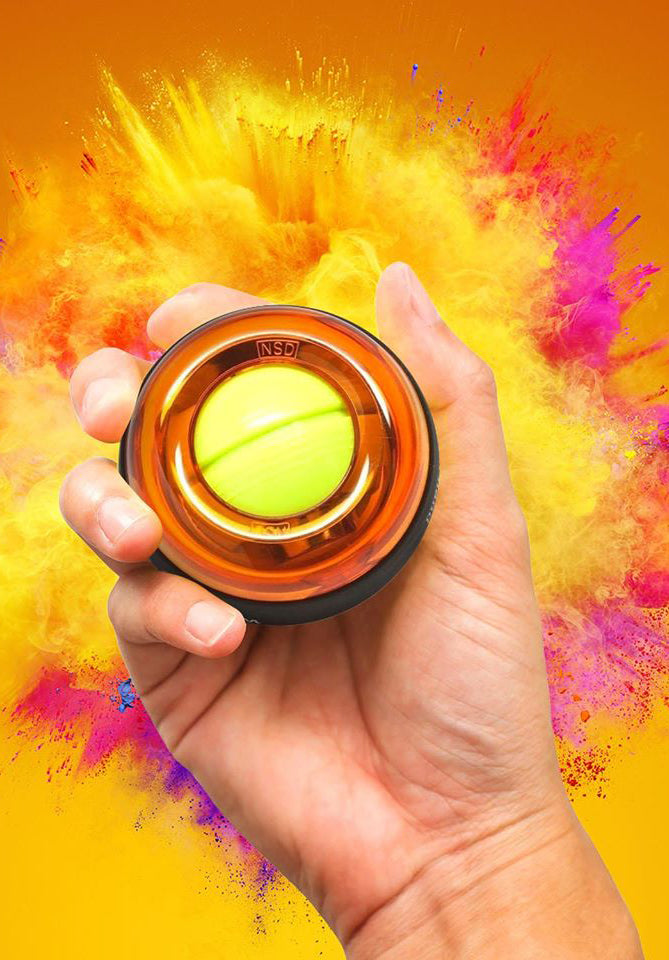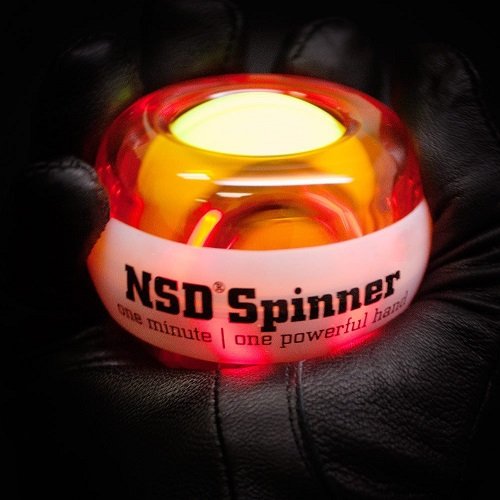
NSD Spinners are scientifically developed to help your arms get the right support they need. Get the right compliment to your arm exercises now.
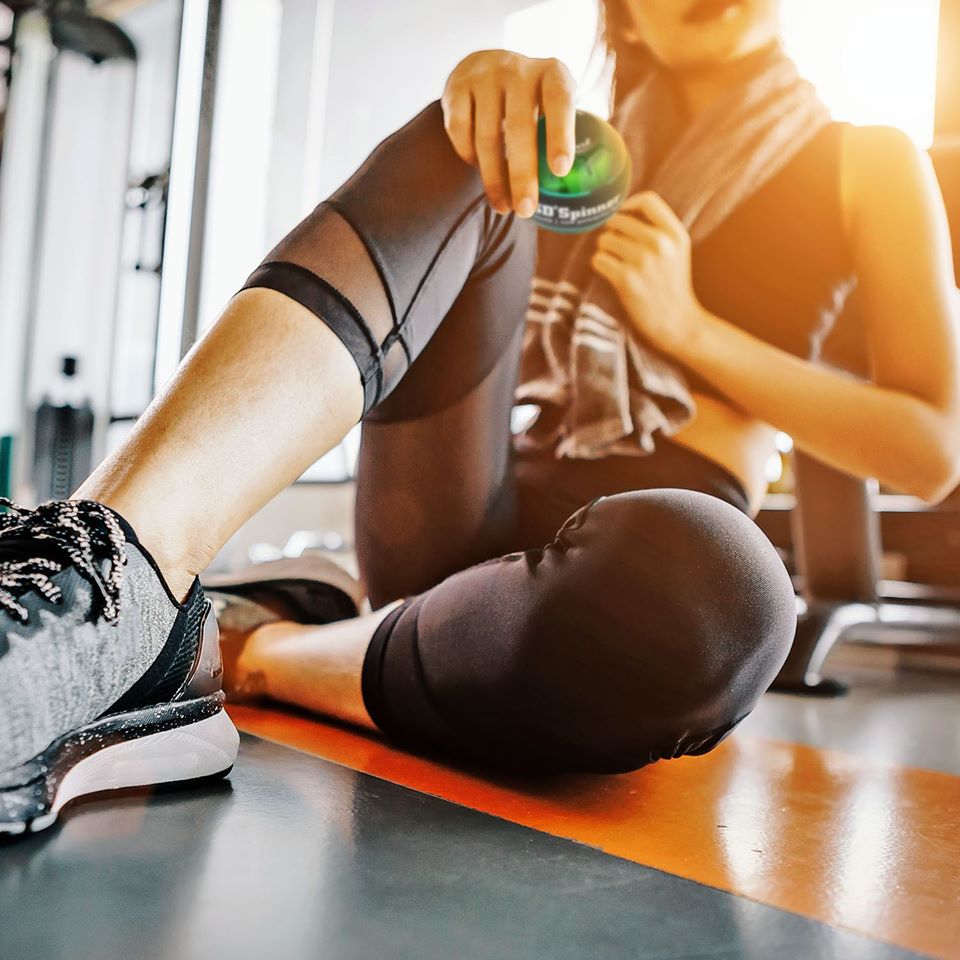
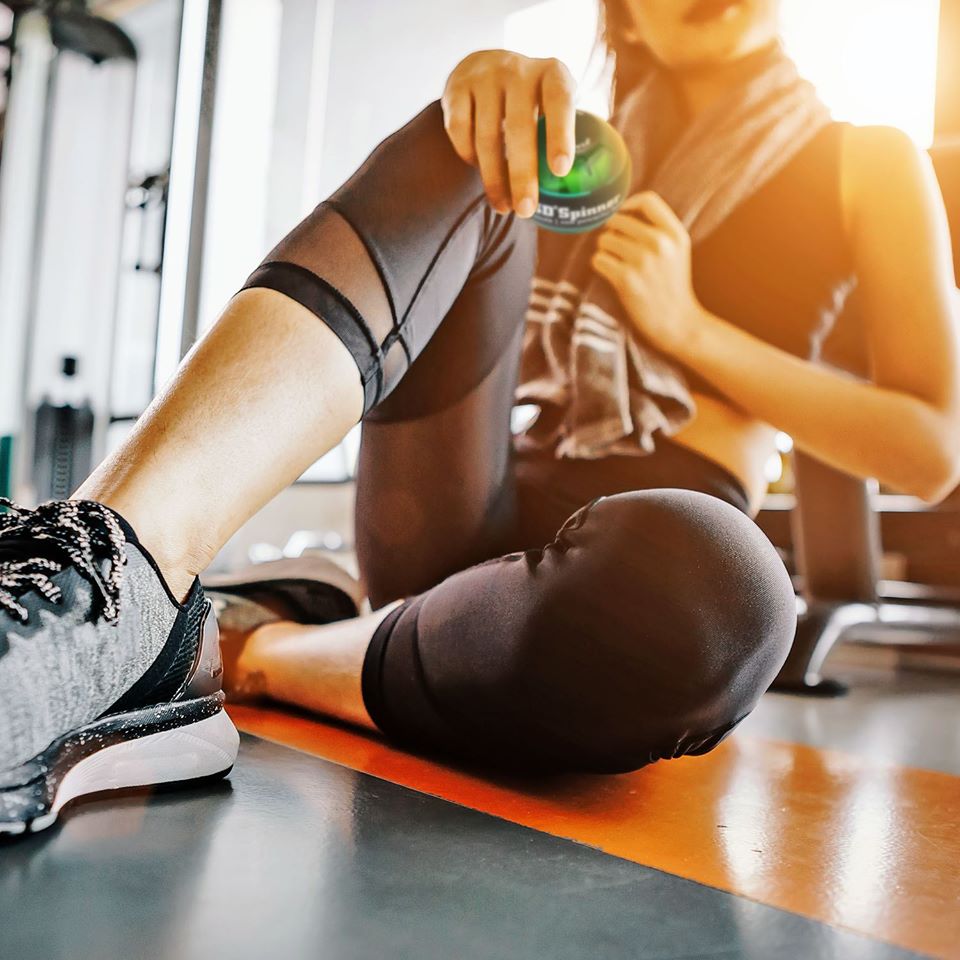
The best hand exercises for pianists target the fourth and fifth fingers — the ring finger and pinky — because those two are anatomically the weakest and the first to fatigue. But the goal is not to force them to become independent. It's to build enough strength and endurance in the muscles that drive them that your control holds up through a full rehearsal. One to two minutes a day is enough — provided you spin fast enough to matter: at least 3,000 RPM for younger players, above 4,000 for adults.
That distinction matters more than any exercise in this article, and the reason why is one of the saddest stories in music history. We'll get to it.
Beyond piano-specific drills, the general skill to build is control — see our full routine of finger independence exercises.
Because of how your forearm is wired — and the ring finger got the worst deal of all five digits. It is the only finger with no dedicated extensor muscle of its own.
| Finger | Dedicated extensor? | What that means at the keyboard |
|---|---|---|
| Index (2) | Yes — extensor indicis proprius | The most independent and controllable finger |
| Middle (3) | No | Shares the common extensor |
| Ring (4) | No | The least independent finger on your hand |
| Pinky (5) | Yes — extensor digiti minimi | Independent, but the shortest and smallest |
It gets more constrained than that. Your ring finger is tied down on both sides:
So when your teacher says your fourth finger is lazy, it isn't lazy. It's tethered. No amount of willpower dissolves a fibrous band.
He ended his own performing career. Every pianist reading this should know the story before touching any strengthening device.
Robert Schumann built himself a contraption — reportedly rigged from a cigar box — designed to strengthen his fingers and break the fourth and fifth fingers' dependence on each other. His hand never recovered, and a concert career became permanently out of reach (Hektoen International). Modern scholarship suggests what he developed was focal dystonia rather than a simple tendon injury (Altenmüller).
That risk is not a historical footnote. Musician's focal dystonia affects an estimated 2–10% of professional musicians, and pianists are among the most affected groups. In pianists it typically shows up as involuntary curling of — of all things — the fourth and fifth fingers. It's painless, task-specific, and driven by changes in how the brain maps the fingers, not by weak muscles. Overuse is among its risk factors (Journal of Hand Therapy, 2024 review).
Here is the line that separates safe training from Schumann's mistake:
| Schumann's device | Sound strength training | |
|---|---|---|
| Type of load | Static, forced position | Dynamic, submaximal, self-paced |
| What it asks of the hand | To do what its anatomy cannot | To get stronger within its existing range |
| Who controls intensity | The device | You do — and you stop early |
Strength is trainable. Independence is largely structural. Train the first. Never try to force the second.
Yes — and notably, it improves things that practising at the keyboard did not. In a 2022 study, 26 pianists with more than 14 years of formal training were randomly split into two groups. One group did a short bout of plyometric finger conditioning — 40 repetitions, in 4 sets of 10. The control group did conventional piano practice for the same amount of time.
The conditioning group showed significantly less variability in both the timing and the loudness of successive keystrokes, plus a higher rate of force development in fingers two through five. The thumb, which didn't perform the conditioning, showed no improvement — a neat internal control. The conventional practice group showed none of these gains. EMG showed no increase in muscle activation, meaning the improvement came from better physiological efficiency rather than simply bigger muscles (Kimoto et al., 2022).
The takeaway for a working pianist: evenness — the thing you chase in every scale and every run — responded to physical conditioning away from the instrument. The study measured an acute effect and the authors are careful about mechanisms, but the direction is clear: your hands are physical equipment, and equipment responds to training.
This is the same logic behind grip strength training generally, applied to a very specific set of small, overworked muscles.
Here's the technique we've found most useful for pianists, and it comes down to one adjustment: take your index finger off the ball.
Your index finger has its own dedicated extensor and a more independent deep flexor tendon. That makes it the dominant digit in any grip — give it a job and it takes over, leaving the weak fingers doing very little. Release it, and the load transfers to the three ulnar digits that share a muscle belly: middle, ring and pinky.

Because on a gyroscopic trainer, speed is the resistance. There is no fixed weight to select. The faster the rotor spins, the more torque it generates, and the harder your fingers have to grip to keep control. That is why "one minute a day" only describes half the workout — a lazy minute at low speed loads almost nothing.
The numbers make the point. Both SpeedX models deliver around 50 lb-in of torque at 10,000 RPM — but torque scales with speed, so that figure collapses as the rotor slows. Spin lazily at a thousand RPM and there simply isn't enough resistance to load the small ulnar muscles you're trying to reach.
| Player | Target spin speed | Model | Size |
|---|---|---|---|
| Teens and smaller hands | At least 3,000 RPM | PB688E SpeedX | 75 mm shell, 286 g |
| Adults | Above 4,000 RPM | PB788E SpeedX | 80 mm shell, 454 g |
Hand size and baseline grip strength vary enormously between a 14-year-old student and a full-grown professional. The same RPM is a different workout for each of them, which is why a single universal number would be misleading — and why the two thresholds above are different.
Don't guess your speed — read it. Both SpeedX models carry an onboard digital counter that shows live RPM, session duration and intensity while you spin, so you can see whether you actually reached 3,000 or 4,000 rather than assuming. That feedback matters more here than in most training: without it, "spin for two minutes" is an instruction with no intensity attached. Both also self-start with a built-in motor — no cord, no winding — which keeps the focus on the spin rather than on getting it going.
Build up to the number; don't lunge at it. If you can't reach your target speed under control with the index finger released, spin with a full grip first and add the four-finger version once your control is solid.
Read this before you start. Stop immediately if you feel sharp pain, numbness, tingling, or any loss of control in the fingers — and see a hand specialist or physician before continuing. Do not train through pain, do not add sessions to speed up results, and do not use this to try to force finger independence. If you already have a playing-related injury, get cleared first. More is not better here; consistency is.
An honest note on what this is: the four-finger grip is our own practical method, built on the anatomy described above. It has not been tested in a published clinical trial. What the evidence supports is that dynamic, full-range grip and forearm training builds strength and endurance, and that off-instrument conditioning can improve keystroke evenness. What it will not do — what nothing can do — is dissolve the juncturae tendinum and make your ring finger anatomically independent.
The same two fingers, for the same anatomical reasons — different job description.
For the full picture across instruments, see our guide to hand exercises for musicians.
Q: Can I make my fourth finger independent?
A: No — not structurally. The ring finger has no dedicated extensor and its tendons are physically linked to its neighbours. You can make it stronger and improve its endurance and force control, which is what actually shows up as evenness in your playing. Trying to force independence mechanically is what ended Schumann's career.
Q: How long should a pianist train, and how often?
A: 1–2 minutes per hand, once a day, at a spin speed of at least 3,000 RPM for teens and smaller hands, or above 4,000 RPM for adults. Both halves matter: the duration sets the volume, the RPM sets the resistance. Extra sessions raise injury risk without speeding up gains.
Q: Will grip training make my hands tight or slow me down?
A: Not at the dosage above, and not if you stretch afterwards. Balanced flexor and extensor work plus a short stretch tends to reduce the end-of-session fatigue that makes playing sloppy. If your hands feel stiff at the keyboard, cut the volume.
Q: Should I train before practising or performing?
A: Not immediately before a performance — never introduce a new variable on a concert day. Train after practice, or on its own. Test any new routine well away from anything that matters.
Q: I already have pain or my fingers curl involuntarily. Should I start this?
A: No. See a hand specialist first. Involuntary curling of the fourth and fifth fingers while playing — especially if it's painless and only happens at the instrument — is a symptom worth having assessed properly. Strength training is not the answer to that problem.
Your fourth finger will never be your index finger. That's anatomy, and two centuries of pianists trying to beat it have produced more injuries than virtuosos.
What you can change is capacity: how much work those small, tethered muscles can do before control starts to slip. That's the difference between a clean run in bar 8 and a smudged one in bar 80.
Wind it. Spin it. Play on.
👉 PB688E SpeedX for younger or smaller-handed players · PB788E SpeedX for adult hands. Both show your live RPM, so you always know you're training at the intensity that actually works.