How to Strengthen Weak Wrists: 3 Exercises That Actually Work (Not Just Wrist Curls)
August 20, 20264 min read
Weak wrists are almost never a bone problem — they’re a strength and control problem. You can’t widen the joint, but you can build the forearm muscles and tendons that wrap around it, and that’s what makes a wrist feel — and perform — strong. The fastest way to strengthen weak wrists is to train grip, wrist rotation, and forearm endurance a few minutes a day. Below are the 3 exercises that do it, and the one-minute tool that keeps you consistent.
Why do weak wrists feel like they never get stronger?
Because most people train the wrong thing. The wrist itself is mostly bone and connective tissue — after your growth plates close, the joint size is locked. What actually moves and stabilizes it are the forearm flexors and extensors, plus the small muscles that control rotation.
A “weak wrist” usually means one of three things: low grip endurance, poor forearm strength, or a flexor/extensor imbalance (the exact imbalance behind tennis and pickleball elbow). Fix those and the wrist stops feeling fragile. Recover the tissue, Reinforce the muscle, Retain the result.
Do wrist curls actually fix weak wrists?
Partly — but they miss half the job. Standard wrist curls train flexion in one plane, which is why people plateau. Real-world wrist strength needs rotation and full-range control, not just up-and-down curls.
That’s why grip athletes, rock climbers, and arm-wrestlers train pronation, supination, and dynamic rotation — the movements a barbell can’t load well. If wrist curls were enough, you wouldn’t still feel weak after months of them.
What are the 3 best exercises to strengthen weak wrists at home?
Here are three that cover grip, forearm mass, and rotation — no gym required.
Exercise
What it builds
Sets / reps
Fingertip dead hang
Grip endurance + tendon strength
3 × max hold (aim 20–40s)
Wrist pronation & supination
Inner forearm, rotation control
3 × 12 each direction
Gyroscopic full-range spin
All-range wrist + grip, low joint load
3 × 1 minute
Step by step:
Fingertip dead hang — Hang from a bar on your fingertips (not full grip). Keep shoulders active. This loads the grip and the tendons that stabilize the wrist.
Wrist pronation & supination — Hold a light dumbbell by one end, forearm resting on your thigh. Rotate the palm up, then down, slowly. This hits the muscles wrist curls skip.
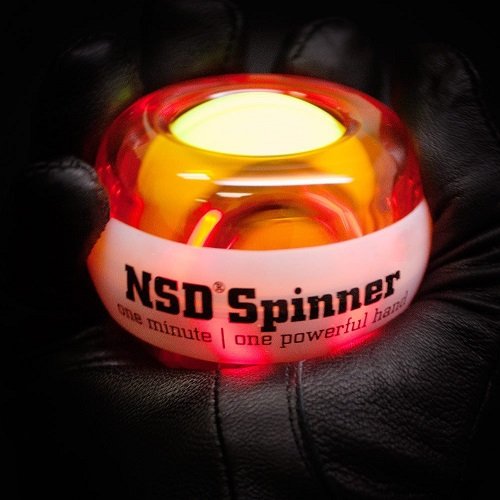
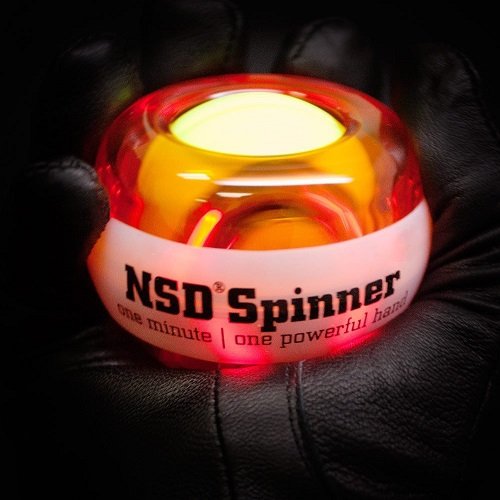
Gyroscopic full-range spin — Wind up a gyro spinner and let it pull your wrist through every angle under resistance. It trains flexors and extensors together, with almost no impact on the joint.
How does a gyroscopic spinner strengthen your wrists faster?
A gyroscopic trainer like the PB-688 Essential Spinner does the one thing dumbbells and bands can’t: it forces your wrist through its full range of rotation under continuous resistance. The faster it spins, the harder it pushes back — so you train grip, flexors, and extensors in a single minute.
It’s also the reason people actually stay consistent. It’s palm-sized, needs no bench or weights, and you can spin it at your desk. In a peer-reviewed study, 8 weeks of gyroscopic-device training improved pain, grip strength, and function in people with tennis elbow (research summary). That’s why we built the Essential Spinner as the easiest possible on-ramp: a manual-start model, starting at $26.99, so a beginner with weak wrists can start today.
It only takes a minute and a few spins. Wind it. Spin it. Do it.
How often should you train your wrists and forearms?
Forearms recover fast, so they handle frequent training well. For most beginners:
Grip/spinner work: 4–6 days a week, 1–3 minutes is enough
Loaded exercises (dead hang, pronation): 2–3 days a week
Progression: add time or resistance every 1–2 weeks, not every session
Consistency beats intensity here. A minute a day, most days, will out-perform one brutal session a week.
Frequently asked questions
Q: Can you actually make weak wrists bigger?
A: You can’t grow the joint or bones, but you can build the surrounding forearm muscle — which makes the wrist look and perform stronger.
Q: Are gyroscopic spinners good for weak or painful wrists?
A: Yes. Because resistance comes from rotation rather than heavy load, a spinner is low-impact on the joint, which is why it’s popular for both strengthening and early-stage rehab. If you have an acute injury, check with a professional first.
Q: Which NSD Spinner should a beginner start with?
A: The PB-688 Essential Spinner. It’s the entry model — manual start, budget-friendly, and the simplest way to build the habit before upgrading.
Q: How long until I feel a difference?
A: Many people notice better grip endurance within 2–4 weeks of near-daily use.
Ready to strengthen weak wrists — starting today?
You don’t need a gym or heavy weights. You need the right movements a few minutes a day, and a tool that makes it effortless to keep going.
👉 Start with the PB-688 Essential Spinner — recover, reinforce, and retain your wrist strength from anywhere.
Subscribe
Sign up to get the latest on sales, new releases and more …